About RF Admittance Type Level Transmitter
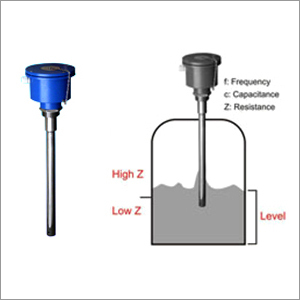
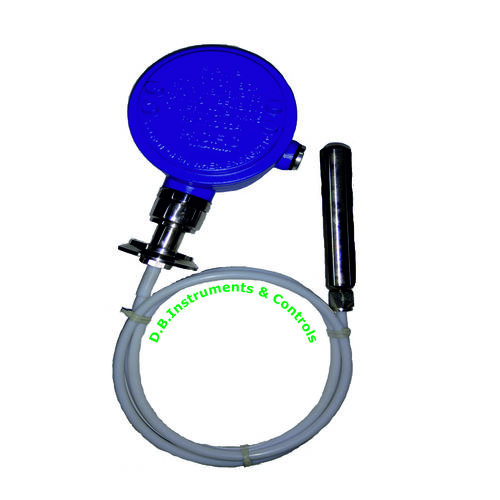
Capacitance & Rf Admittance Type Level Transmitter:A capacitance is formed between the probe and the vessel wall. As the level of the measuring medium rises or falls capacitance between the probe and vessel wall changes proportionately. A high frequency sine wave is applied between the probe and tank wall. A change of medium level will induce a change in the current of the applied sine wave. From when the capacitance in the vessel increase, impedance will decrease and current will increase and vice-versa. (Z=Resistance, C=Capacitance, F= Frequency).
Capacitance & RF Admittance Type Level Transmitter:
Technical Specification:
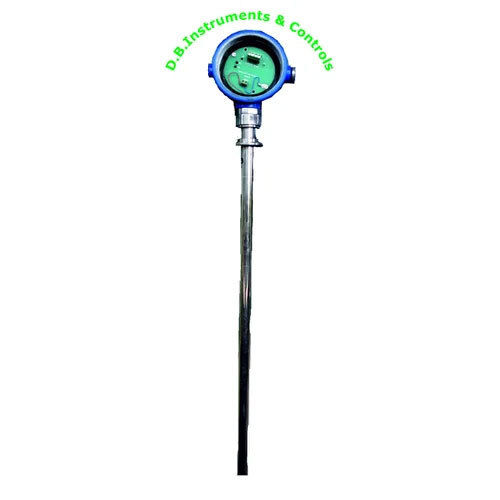
- Mahalaxmi make RF admittance/capacitance type 3 wire Level transmitter Model (CLT-1) with non insulated probes
- for non-conductive liquids
- Frequency of operation : 5 to15kHz.
- Process connection : 3/4",1",1.1/2" BSP(M) or 1 "ASA 150 lbs flanged but thickness 12mm
- (or as per customer specification)
- Power supply : 24VDC
- Output : 4 to 20 mA.(non-isolated)
- Span & Zero adjustment : Trim pots
- Max.Working Pressure : 10kg/sq.cm
- Max.Working Temp. : 150deg.C
- Accuracy : +/-0.5%,+/-1% or +/-2%
- Enclosure : Cast aluminium weather proof with PG9 cable gland or Flame proof
- (IS2148-2004,Gr II A and B gases)
- Cable Size : 3 core, 0.75 sq.mm screened PVC cable.
Versatile Measurement CapabilityThis level transmitter can measure a wide range of application media, including liquids, slurries, powders, and granules. With adjustable probe type and customizable cable lengths up to 30 meters, it adapts easily to various tank sizes and installations. The device ensures reliable operation in harsh industrial settings.
Advanced Output & ConnectivityEnjoy precise data transmission with 4-20mA output and optional HART support for digital communication. The transmitters two- or three-wire configurations make it compatible with existing control and monitoring systems, streamlining integration within both new and retrofit projects.
Robust Design & Safety ComplianceOffering ingress protection up to IP68 and explosion-proof variants, the transmitter is engineered to perform safely in hazardous areas. Its aluminum or stainless steel enclosure ensures durability, while high isolation voltage and comprehensive electrical connections provide enhanced operational security.
FAQs of RF Admittance Type Level Transmitter:
Q: How does an RF Admittance Type Level Transmitter measure the level of different media?
A: This device uses RF admittance technology, generating a field between its probe and the tank wall. Changes in capacitance or admittance caused by media presencesuch as liquids, slurries, powders, or granulesare detected and converted into proportional output signals.
Q: What configurations are available for process connections and probes?
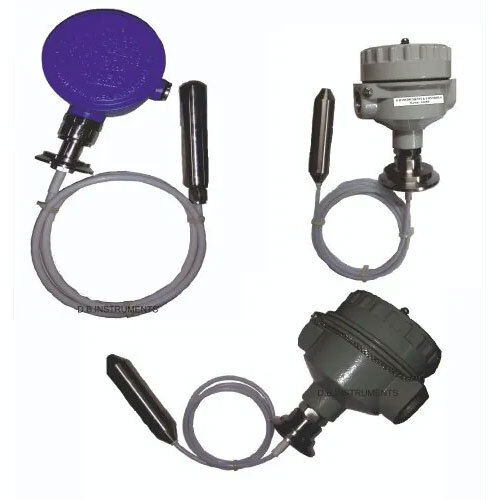
A: The transmitter can be tailored with either threaded or flanged process connections, based on installation requirements. Probe options include rod, cable, or coaxial, which are selected according to tank dimensions, mounting location, and the type of media being measured.
Q: When is explosion-proof certification necessary for this equipment?
A: Explosion-proof (ATEX/IECEx/CMRI) options are recommended when installing the transmitter in hazardous areas with flammable gases, vapors, or dust. Safety certifications ensure compliance with industrial standards for safe operation in such environments.
Q: Where can this level transmitter be mounted in a process setup?
A: It supports both top and side mounting, allowing flexible installation on tanks, silos, vessels, or bins. Proper mounting position depends on the container design and accessibility for probe deployment and routine maintenance.
Q: What is the typical response time and accuracy of this transmitter?
A: The transmitter provides a fast response time of less than 1 second and high measurement accuracy of 0.25% of full scale, ensuring rapid and reliable level detection even in dynamic process conditions.
Q: How is the transmitter powered and what are its electrical connection options?
A: It operates on 24VDC and typically consumes less than 3W. Electrical connections are available via cable gland or plug & socket, supporting cable lengths up to 30 meters for flexible site wiring and integration.
Q: What are the main benefits of using an RF Admittance Type Level Transmitter in industrial applications?
A: Key advantages include suitability across diverse media, robust performance in extreme temperatures and pressures, support for hazardous locations, easy integration with control systems, and low maintenance requirements due to non-contact operation and self-cleaning properties.











 Send Inquiry

 Send Inquiry
 Send Inquiry
 Send SMS
 Call Me Free